

Before booking corporate travel, confirm who will receive the invoice, which references it must carry, what the quoted price includes and when payment falls due. These details help finance match the bill to an approved journey without chasing the passenger afterwards.
Britannia Cars’ corporate travel service lists automated monthly invoices, journey logs and cost centre allocation. Agree how those features will work for your business before the first booking.
1. Confirm the Billing Company and Invoice Details
Give the booking team the full legal name and billing address of the business paying for the journey. A passenger’s name or office location alone may not identify the correct customer, especially where several companies share premises.
Provide the accounts payable email separately from the passenger’s contact details. Confirm whether invoices should also go to the person who arranged the trip.
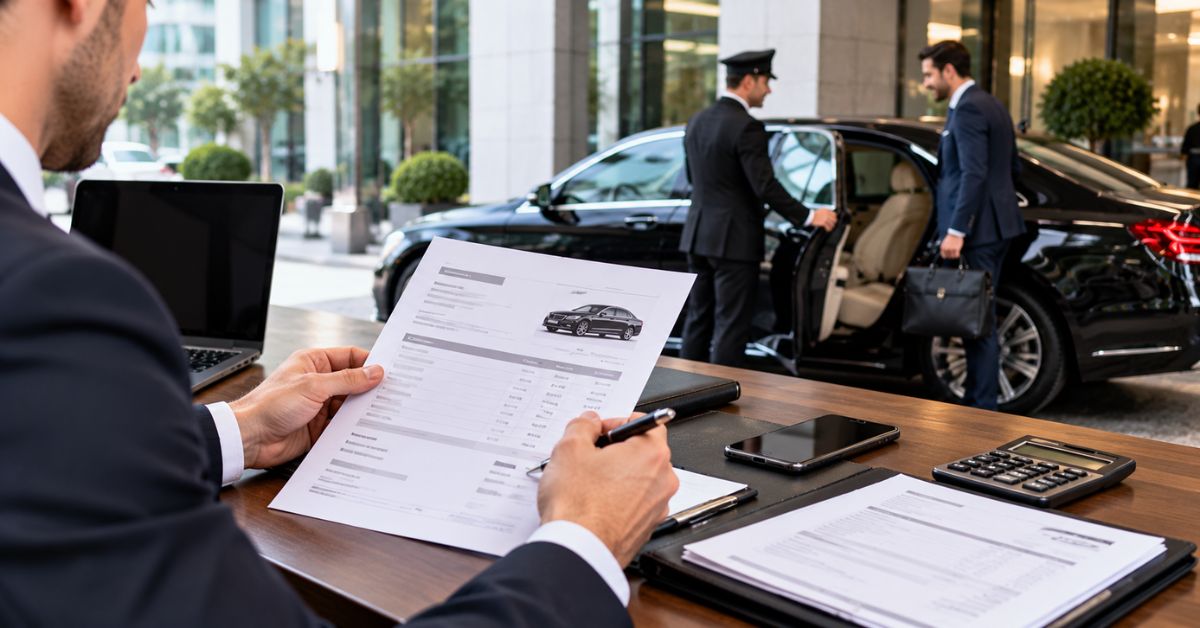
Ask to see a sample invoice. Check that it includes the supplier’s details, a unique invoice number, the customer’s name and address, the invoice date, the service date, a clear description, the charges and the total payable. VAT should be shown where applicable.
2. Establish How VAT Will Be Shown
Ask whether the quote includes VAT, excludes VAT or has no VAT charged. Do not assume the headline fare is the amount your business will ultimately pay.
Where VAT is charged, ask for an appropriate VAT invoice. If your finance team needs a full VAT invoice, confirm that it will show the supplier’s VAT registration number and the relevant net charges, VAT rates, VAT amounts and gross total.
A booking confirmation or payment notification should not automatically be treated as the VAT document finance needs. Settle the document requirements before approving the fare.
3. Supply Purchase Order and Cost Centre References
Check your company’s purchasing rules before requesting travel. If a purchase order is required, obtain it early and tell the booking team exactly where its number must appear.
Other useful references include:
- Department or cost centre code.
- Project, client or matter number.
- Employee or traveller reference.
- Name of the person authorising the booking.
These are internal approval details, distinct from standard invoice information. Agree whether they belong against each journey or at invoice level.
For example, two journeys charged to different departments need separate allocation even when the same employee takes both trips.
4. Define What the Agreed Fare Covers
An invoice is easier to approve when the original quote describes the journey properly. Confirm the pickup and destination, date, scheduled time, passenger numbers, luggage requirements and vehicle category.
Then establish whether the price covers a single transfer, a return journey or a vehicle retained between appointments. A return booking should make clear whether both legs are included.
Ask specifically about parking, airport access charges, tolls, additional stops, meet-and-greet arrangements and any minimum hire period. Identify which costs are included and which could be added.
For business airport transfers, provide flight and terminal details so the collection arrangements can be quoted accurately. Keep the accepted quote with the booking record.
5. Agree Waiting, Changes and Cancellation Charges
A meeting running late can change the final bill. Before booking, establish any included waiting allowance, when chargeable waiting begins and how further time is calculated. Ask whether partial charging periods are rounded up.
For airport collections, clarify how flight delays affect pickup timing and waiting charges. Flight monitoring alone does not explain the charging policy.
Also confirm the cancellation deadline, applicable charges, no-show conditions and who may authorise a change that increases the price.
Britannia Cars’ booking terms state that waiting arrangements and change or cancellation policies depend on the confirmed booking. Use those specific conditions when approving travel.
6. Check the Monthly Billing and Reporting Format
For regular travel, confirm the billing period, invoice issue date and treatment of journeys booked in one month but completed in another. Ask whether late adjustments appear separately or on the next bill.
Monthly billing should still let finance trace individual trips. Agree the journey references, travel dates, route descriptions and cost centre details needed in the accompanying log.
Ask whether the supporting information is available in a spreadsheet or another usable format; do not assume a particular export is included.
Request a sample covering several journeys. Finance can then check whether the format works before the account starts generating a larger volume of bookings.
7. Separate the Billing Cycle From Payment Terms
Receiving one invoice each month does not, by itself, establish how long you have to pay. Confirm the due date, the event from which the payment period runs and the accepted payment method.
If payment is due a stated number of days after invoicing, check whether that means calendar days. Align the arrangement with your company’s payment run.
Where a deposit or advance payment is required, ask how it will appear against the final balance. Record any agreed credit limit and what happens if outstanding charges reach it.
The booking confirmation should reflect these arrangements before anyone relies on account billing.
8. Establish How Invoice Queries Will Be Resolved
Ask who handles billing questions and what supporting information they need. A useful query should identify the invoice number, journey reference, disputed item and expected amount.
Keep the original quote, booking confirmation and approved changes together. If an extra stop was authorised during the journey, retain that approval alongside the booking.
Confirm how corrections and credits will be documented, and whether a disputed line affects payment of the remaining balance. Finance should follow the agreed process rather than silently reducing a payment.
For ongoing accounts, nominate one internal contact to coordinate queries and prevent contradictory instructions.
Frequently Asked Questions
Is a card receipt the same as a travel invoice?
A card receipt confirms payment. It may not contain the journey, customer and tax details needed for accounting, so request the appropriate invoice as well.
Can my company receive the invoice when a client is travelling?
Ask for your company to be recorded as the billing customer and the client as the passenger. Confirm this when arranging the trip.
Does requesting a corporate account automatically confirm a booking?
No. Britannia Cars’ terms say a booking is confirmed only when the company accepts the request and provides confirmation. Check account setup and journey confirmation separately.
Can an invoice be divided between two companies?
Ask before booking whether separate invoices can be issued. Supply each legal entity’s billing details and agree how the fare and any extras will be divided.